 Rhumb
Hold a heading
On choosing one bearing and steering it, even when a shorter line exists.
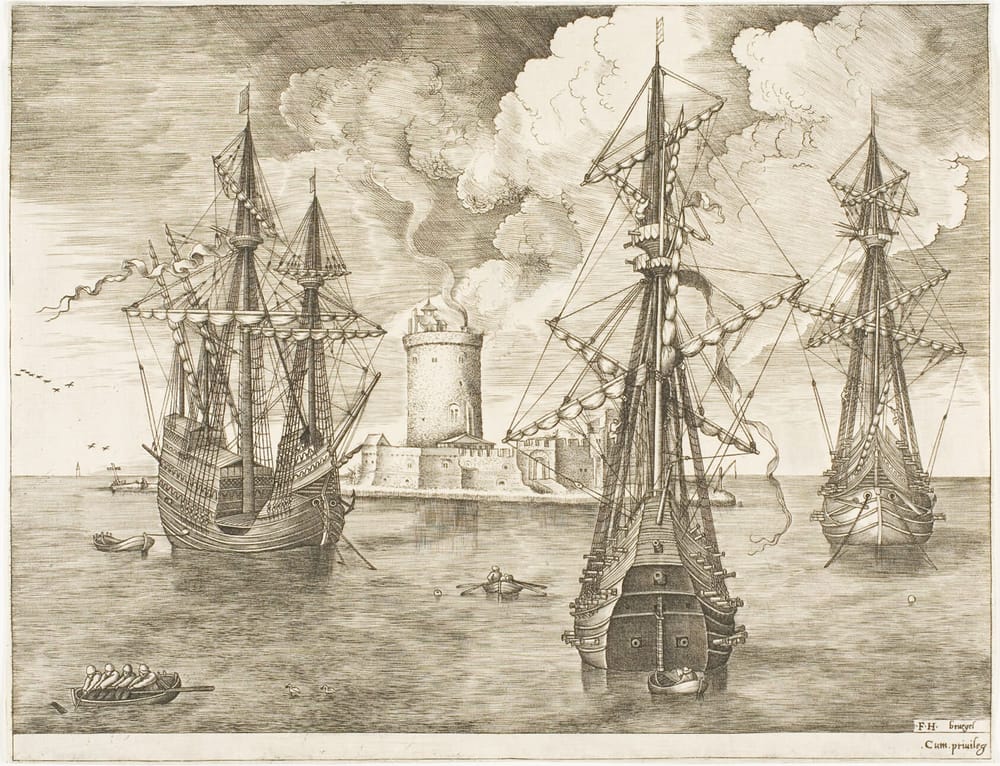
The first thing they teach you at the helm is not how to steer. It is how to stop steering. A new hand grips the wheel like a rope over a drop and corrects every twitch of the compass card, and the boat answers each correction a little late, so that the wake behind her looks like a signature. The mate lets this go on for about ten minutes. Then he says the same thing mates have said for three hundred years: pick a number and leave her alone.
I have been thinking about that sentence for most of a year, because I think it is the best advice about writing I was ever given, and nobody who gave it to me was talking about writing.
The line you can steer
A rhumb line is the course you get when you hold one compass bearing and refuse to change it. On a chart drawn to Mercator’s projection it is a straight line, which is the whole reason the projection exists. On the actual globe it is a shallow spiral, crossing every meridian at the same angle, bending gently towards the pole.
It is not the shortest route. The shortest route between two points on a sphere is a great circle, and over an ocean the difference can be a day’s sailing. Every navigator has known this since the sixteenth century. They went on drawing rhumb lines anyway, for a reason that has nothing to do with geometry: a great circle asks for a new heading every few hours, and a tired crew on a wet deck at three in the morning does not reliably deliver new headings. One number, written on the slate by the binnacle, survives a change of watch. A sequence of numbers does not.
So the rhumb line is a compromise, but it is a particular kind of compromise. It trades away a small amount of efficiency you could have on paper for a large amount of reliability you will actually get. I have come to think most good working methods are rhumb lines.
What drift looks like from the inside
The trouble with holding a heading is that a heading is not a position. You can steer 087 degrees with perfect discipline for two days and still end up eleven miles south of where you meant to be, because the water you were sailing through was itself moving. Current does not show on the compass. Neither does leeway, the slow sideways slide of a hull under sail. From the helm, a boat being set quietly off her track feels exactly like a boat that is on it.
This is the part that transfers most directly, and most uncomfortably, to a desk. For three years I kept a notebook of what I intended to write each week, and a second record, less flattering, of what I had in fact written. The intentions were consistent. I was always on course. It was only when I laid the two side by side, the way you lay a ruler between the reckoned position and the fix, that I could see the set: every piece had come out about a fifth more cautious than I had planned it. No single decision had done that. It was a quarter knot of current, applied for a thousand hours.
You cannot feel a quarter knot. You can only measure it, afterwards, against something that does not move.
A heading is a promise about direction. Only a fix tells you whether the sea agreed.
Taking a fix
The discipline that makes dead reckoning safe is not better steering. It is the regular, slightly humbling act of finding out where you are by some means that does not depend on where you think you are. A star at dusk. The bearing of a headland. A sounding, if the bottom is shaped helpfully. You plot the result, you draw a small circle round it, and you write the time beside it. Then you look at the distance between that circle and the cross where your arithmetic had put you, and you do not argue.
Good navigators differ from poor ones less in the size of that gap than in what they do with it. The poor one rubs out the cross and carries on. The good one measures the gap, works out its direction and its rate, and writes it in the log as a fact about the water: set 200, drift half a knot. The error has become information. Tomorrow’s course will lean a few degrees into it.
For anyone who makes things, the equivalent of a fix is any contact with a reader that you did not arrange for your own comfort. A reply from someone who misunderstood the second paragraph. A piece you were proud of that nobody finished. The old essay you reread and find, to your surprise, better than the one you are writing now. These are bearings on fixed objects. They are worth more than any amount of confident reckoning, and they are worth nothing at all if you rub them out.
The watch system
There is a practical side to all this that romantic accounts of the sea tend to leave out. Nobody holds a heading for a week. One person holds it for four hours, and then someone else does, and the thing that makes this possible is a set of small, dull conventions that have barely changed since the age of sail.
- The course is written down where the next helmsman will see it, not remembered.
- The watch is handed over aloud, in a fixed form: course, speed, weather, anything odd.
- The log is filled in every hour whether or not anything has happened.
- Whoever is relieved stays on deck until the new hand’s eyes have adjusted to the dark.
None of this is interesting, and that is its virtue. The conventions exist so that the boat’s direction does not depend on anyone’s mood, memory or talent at four in the morning. I used to think of routine as the enemy of good work. I now think of it as the slate by the binnacle: the place where the heading lives when I am too tired to hold it in my head.
My own version is almost embarrassingly small. I write the next morning’s first sentence before I stop for the day. I keep one line, at the top of the file, that says what the piece is for. When I come back to the desk I read that line before I read anything else, and most mornings it tells me that the clever paragraph I was planning does not belong.
When to alter course
It would be easy to turn all this into an argument for stubbornness, and the sea does not support that argument. Ships that hold a heading into a lee shore are not disciplined. They are wrecks with good paperwork. The rule was never do not change course. The rule is that a change of course is an event. It is decided, on evidence, by someone with the chart in front of them; it is given as an order; and it is written in the log with the time and the reason.
What the rule forbids is the other kind of change, the kind the nervous beginner makes forty times an hour: the correction that responds to the last wave and not to the passage. Those corrections feel like attention. In the wake they look like indecision, and they cost distance every time the rudder bites.
I notice the same two kinds of change in my drafts. There is the deliberate one, where I can say in a sentence what I learned and what I am doing about it. And there is the twitch: a new opening because the old one bored me this morning, a paragraph softened because I imagined one particular reader frowning. The first kind has a date and a reason. The second kind only has a mood.
Landfall
The reward for all of this arrives without ceremony. Some time on the last day, a smudge on the horizon hardens into a shape, and the shape is the one in the pilot book, on the bearing you expected, within an hour of when you expected it. Nobody cheers. Someone goes below and puts the kettle on.
It is a strange kind of satisfaction, because it is the satisfaction of nothing having gone wrong, and it is assembled entirely out of things that were boring at the time: the hourly entries, the fixes plotted and believed, the single number on the slate. You did not out-think the ocean. You picked a line you could steer, you checked it against the world as often as the world allowed, and you let the corrections be few and deliberate.
I do not know a better description of how a long piece of work gets finished. Pick a number. Leave her alone. Take the fix when the stars come out, and write down what it tells you, especially when you would rather it had told you something else.